The way agricultural, forestry and landscaping work is being managed is changing. Machinery is no longer viewed only as a way to replace manual labor. Increasingly, equipment is expected to help businesses complete difficult jobs with fewer workers, improve operational efficiency and make better use of available labor.
This trend is becoming particularly visible in agriculture and land management. A recent study released by the Brazilian Confederation of Agriculture and Livestock (CNA) found that labor shortages have become a major challenge for farmers. According to the study, 44.5% of surveyed producers identified labor availability as their main challenge, while 94.8% reported difficulties with hiring. The research also found that 42.6% of producers had brought forward investments in mechanization and automation as a response.
This does not mean that machinery will simply replace workers. Instead, it shows a more practical direction: businesses are looking for machines that allow existing teams to complete more work efficiently.
For many farms, orchards, gardens and landscaping businesses, mowing is a repetitive task. It can require large amounts of time, especially when grass and weeds need to be controlled regularly.
Flat lawns are relatively straightforward. The challenge becomes much greater when the working environment includes slopes, uneven ground, orchards, rough vegetation or areas where conventional riding or walk-behind machines are inconvenient.
This is where remote-control mowing technology becomes increasingly relevant.
Instead of requiring the operator to remain directly on the machine, a remote-control mower allows the operator to control the equipment from a distance. This changes the way mowing operations can be organized.
The operator can remain outside the immediate working path while controlling the machine, observing the terrain and adjusting the mowing direction according to the actual conditions.
For farms and professional landscaping companies, this can create a different workflow: one operator can focus on controlling the machine while the machine handles repetitive cutting work across challenging terrain.
One of the most important factors when selecting a remote-control mower is not simply engine power. The working environment matters just as much.
A machine designed for a residential lawn does not necessarily have the same requirements as a machine used in an orchard, farm or rough grassland.
Kesen Machinery's remote-control mower range is designed around different application scenarios, including home lawns, gardens, orchards and farms. The company's product structure reflects an important point in machinery selection: the machine should be matched to the working environment rather than selected only according to one specification.
For example, orchards may require the machine to work between trees and across uneven surfaces. Farms may involve larger areas and longer working cycles. Landscaping contractors may encounter different terrain at every customer site.
Therefore, factors such as cutting width, power, track or wheel configuration, slope capability, remote-control distance and machine weight all become part of the decision.
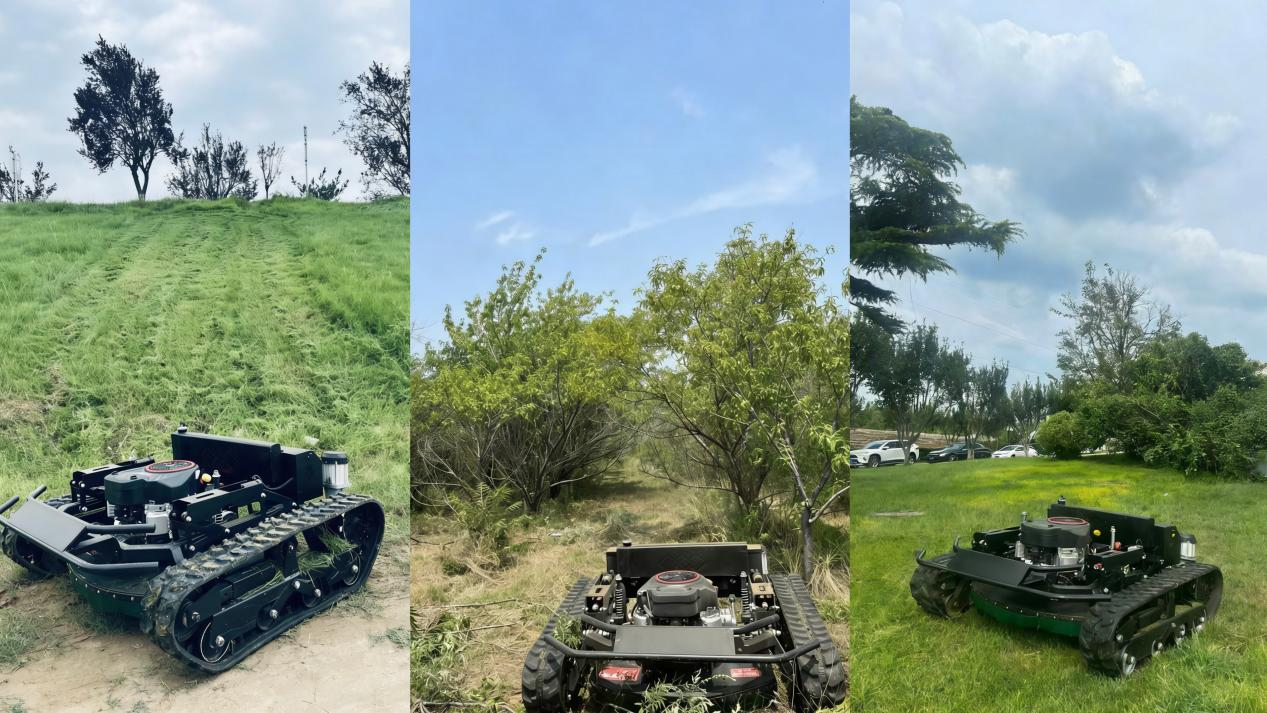
Among Kesen's remote-control mower solutions, the KS900 is designed for larger and more demanding mowing applications.
The KS900 has a 90 cm cutting width and is equipped with a 22 HP Loncin engine. It is designed for slopes up to 65 degrees and uses metal tracks, a brushless motor and a Hypoid gearbox. With a machine weight of approximately 386 kg, its configuration is intended for applications where traction and terrain adaptability are important considerations.
The value of this type of machine is not simply the number of horsepower or the maximum slope figure.
The more important question is what happens when these specifications work together.
A wider cutting width can help reduce the number of passes required. A tracked structure can provide a different approach to uneven terrain compared with conventional wheeled equipment. Remote operation can allow the operator to control the machine without having to sit directly on it.
For professional users, these details can directly affect the daily workflow.
The development of agricultural machinery in 2026 also shows that automation is becoming more practical.
At Agrishow 2026 in Brazil, one of the major themes was the increasing use of connectivity, artificial intelligence, automation and embedded technology in agricultural machinery. The event highlighted a broader industry movement toward machines that can assist operators, automate parts of the work process and improve operational decision-making.
This development is important for remote-control equipment as well.
Not every application requires a fully autonomous machine. In many real-world situations, remote control is already a useful intermediate solution. It gives the operator direct control while allowing the machine to take on physically demanding or repetitive work.
This makes remote-control technology particularly interesting for farms, orchards and landscaping businesses that need practical automation rather than complicated systems that require major changes to their existing workflow.
A good machinery decision should begin with the application.
How large is the area? Is the terrain flat or sloped? Is the vegetation soft grass, weeds or heavier vegetation? Are there trees, obstacles or narrow working areas? How frequently will the machine be used? Does the operator need to work from a distance?
These questions are often more important than simply asking which machine has the largest engine.
At Kesen Machinery, we believe machinery should be developed around real working conditions. Since our establishment in 2003, we have focused on forestry and garden machinery and have continued to develop equipment for different land-management applications.
As labor availability changes and agricultural and landscaping businesses continue to focus on efficiency, remote-control mowers are likely to become an increasingly practical part of modern land management.
The goal is not technology for technology's sake.
The real goal is simple: helping people complete difficult outdoor work more efficiently, with machinery that matches the terrain, application and working requirements.
For farms, orchards and professional landscaping teams, that is where the value of remote-control mowing technology becomes most visible.
 Hot News
2026-06-16
2024-12-26
2024-12-26
2024-10-11
2024-09-18
2024-09-09
Kesen Machinery was founded in 2003 with the goal of producing high-quality products for customers and providing world-class equipment support for all forestry and construction customers.
Copyright © Shandong Kesen Machinery Manufacturing Co., Ltd. All Rights Reserved- Privacy Policy- Blog
 EN