Published by Kesen Machinery Technical Engineering Team | Reading Time: ~6 mins | Target Audience: Sawmill Operators, Forestry Contractors & Woodworking Businesses
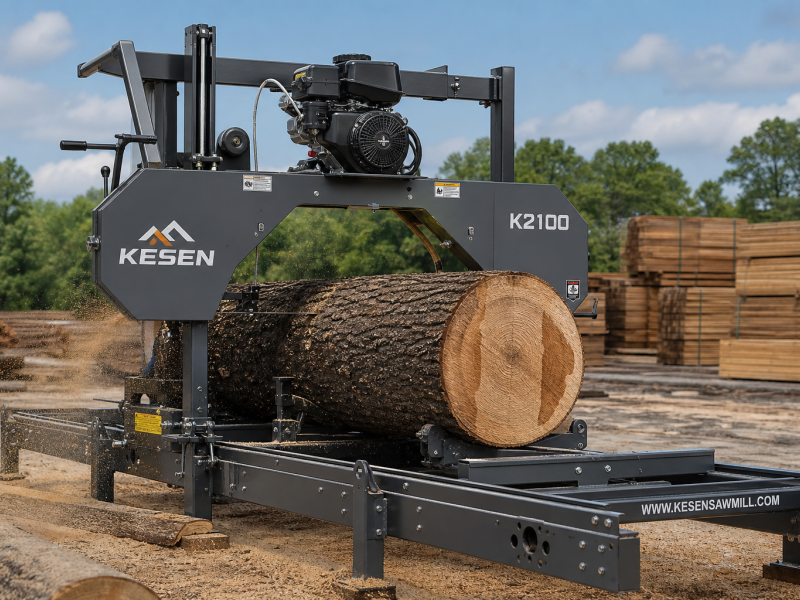
Figure 1: Kesen Heavy-Duty Portable Horizontal Band Sawmill in Commercial Timber Operation
1. Introduction & Modern Timber Industry Trends
Across North America, Europe, Australia, and emerging forestry markets, the economics of lumber production are undergoing a decisive structural shift. Skyrocketing commercial timber transportation costs, surging demand for live-edge architectural slabs, and the expansion of urban wood salvage have elevated the portable horizontal band sawmill from a niche rural tool into a primary profit engine for modern forestry contractors, custom woodworkers, and commercial timber yards.
Traditional stationary circular sawmills produce wide kerfs—frequently chewing up to 1/4 inch (6.35 mm) or more of valuable timber into sawdust with every single pass. In contrast, modern portable bandsaw mills utilize specialized thin-kerf bandsaw technology (cutting a kerf of just 0.080 to 0.100 inches / ~2 mm). By saving up to 25% to 30% of each log from turning into low-value sawdust, operators immediately extract an extra board out of every four cuts. When processing prized hardwoods like black walnut, white oak, cherry, or figured maple, this recovery differential translates into thousands of dollars in added daily margin.
As an established global manufacturer of precision outdoor and forestry equipment, Shandong Kesen Machinery engineers robust horizontal band sawmills engineered with rigid modular track beds, high-torque industrial gasoline and electric powerheads, and vibration-damped blade guide systems designed to deliver millimeter-level dimensional accuracy in tough outdoor field conditions.
2. High-Impact Application Scenarios
A commercial-grade portable band sawmill proves its value across a diverse spectrum of high-revenue and cost-saving operations:
• On-Site Forestry & Remote Timber Salvage: Transporting oversized, crooked, or remote timber logs to distant stationary mills incurs punishing freight bills. Mobile sawmills mounted on reinforced highway-grade trailer packages can be towed directly to the felling site, converting downed logs into squared cants and dimensional lumber right where the trees fall.
• Specialty Slabs & Architectural Woodworking: Standard commercial sawmills reject large butt logs, burls, and urban storm-damaged trees due to irregular shapes or potential foreign metal inclusions. Portable horizontal sawmills equipped with wide cut throats (up to 28" to 36" log diameter capacity) empower woodworkers to mill premium live-edge dining tables, mantle beams, and custom bookmatched slabs commanding 300% to 500% retail price markups.
• Agricultural, Farm & Homestead Infrastructure: Ranchers, vineyard managers, and agricultural estates continuously require structural posts, fence boards, equipment shed framing, and barn cladding. Utilizing wind-thrown or thinned pine and cedar logs eliminates retail lumber purchases, achieving total machine payback within the first 40 to 60 logs milled.
• Commercial Micro-Sawmilling Enterprises: Entrepreneurs offering custom mobile contract sawmilling charge lucrative hourly or board-foot rates ($80–$150/hour or $0.40–$0.70 per board foot), providing an agile, low-overhead business model that scales effortlessly with regional building demand.
3. Essential Selection Criteria: How to Choose the Right Sawmill
Selecting the optimal sawmill requires evaluating structural geometry, power plant dynamics, and mechanical ergonomics. The comparison table below highlights the critical engineering parameters buyers must weigh:
| Evaluation Factor | Standard Entry / Hobby Units |
Kesen Heavy-Duty Commercial Series |
| Bed Construction & Frame | Bolt-together C-channel or stamped rails; prone to torque flex on heavy logs. | Structural box-steel ladder frame, ground precision tracks, modular bolt-on bed extensions. |
| Log Throat Capacity | 20" to 24" max diameter; limited vertical head clearance for thick cants. | 28" to 36" max log diameter with up to 32" cant width; handles massive forest timber. |
| Powerhead Options | 6.5 HP to 9 HP standard engines; bogs down easily when cutting dry dense hardwood. | 14 HP to 23 HP industrial gas engines (Lifan/Kohler/Honda) or 7.5kW-11kW electric motors. |
| Blade Guide & Tensioning | Basic ceramic blocks; mechanical screw tension without visual torque gauge. | Hardened steel roller guides, hydraulic/cam tensioner with quick-release and gravity drip. |
Key Takeaway: Never sacrifice track bed rigidity for initial cost savings. A sawmill frame is the fundamental datum plane for your cuts. If the frame flexes under a 1,500-lb log, no amount of operator skill can produce true, wave-free lumber.
4. Pro Operation & Preventative Maintenance Best Practices
Achieving consistent board thickness and maximizing blade life requires disciplined operational protocols. Follow these professional field guidelines:
A. Log Preparation & Clamping Integrity
Before rolling logs onto the track bunks, thoroughly scrape or pressure-wash bark to remove embedded sand, grit, and mud. Silica from road grit is the primary killer of sharp bandsaw teeth, dulling a brand-new blade in under 10 board feet. Position log dogs securely to clamp both sides of the cant, preventing rotational stress during the cut.
B. Blade Tooth Geometry & Tension Tuning
Match your blade profile to the timber species. For softwoods (pine, spruce, cedar), select a 10° tooth hook angle with deep gullets to efficiently clear high volumes of fibrous sawdust. For dense, dry hardwoods (oak, maple, hickory), shift to a 7° or 4° hook angle to prevent blade chatter and wave deviation. Always verify blade tension when starting and recheck after the first 15 minutes of operation as steel warms up.
C. Scheduled Maintenance Matrix
• Daily / Pre-Shift: Inspect blade band wheels and drive belts for pitch accumulation. Clear sawdust build-up from track rails. Check gravity water lube reservoir (mix water with a drop of biodegradable pine cleaner to prevent resin adhesion).
• Every 4-6 Operating Hours: Swap out the bandsaw blade. Never run a blade until it is completely dull. Swapping blades early allows the metal to rest, preventing premature micro-fractures in the gullets and enabling 3 to 5 re-sharpening cycles.
• Monthly / 50 Hours: Verify track bed leveling with an engineer's level. Inspect roller guide bearings for axial play. Grease drive shaft bearings and check engine oil and air filter condition.
5. In-Depth Frequently Asked Questions (FAQs)
1. How much lumber yield advantage does a thin-kerf band sawmill provide over a circular saw?
A commercial band sawmill blade has a cutting kerf of roughly 0.080" to 0.100" (2.0–2.5 mm), whereas circular saw blades remove 0.250" (6.35 mm) or more per pass. On a standard 20-inch log yielding twelve 1-inch boards, a circular saw converts nearly 3 full inches of timber into sawdust. The band sawmill saves approximately 2 full boards per log—a 20% to 30% direct increase in usable lumber yield.
2. Gasoline engine vs. Electric motor: Which is better for my sawmill setup?
It depends entirely on your primary operating location. A gasoline engine (e.g., 15 HP to 23 HP) is essential for field mobility, remote timber tracts, and custom sawmilling where 3-phase grid power is unavailable. If you operate inside an enclosed workshop or permanent timber yard with 380V/220V power, an electric motor (7.5 kW to 11 kW) offers whisper-quiet operation, zero exhaust fumes, immediate pushbutton startup, and significantly lower routine maintenance costs.
3. How do I prevent 'wavy cuts' when milling through knotty hardwood logs?
Wavy cuts are typically caused by one of three factors: insufficient blade tension, an overused dull blade, or an improper feed speed. When the saw head enters dense knots, a dull blade will deflect upward or downward. Ensure blade tension is set to factory specifications (typically 2,500–2,800 PSI equivalent on gauge), maintain roller guide spacing within 0.010" of the blade back, and ease forward feed pressure when entering knottier heartwood.
4. Can track beds be extended for cutting long architectural beams?
Yes. Kesen horizontal band sawmills are designed with modular bolt-on bed sections. Standard packages cut logs up to 13–19 feet (4–6 meters), but operators can seamlessly bolt on 6.5-foot (2.0-meter) track extensions to cut continuous beam lengths of 30 feet or more for post-and-beam construction, timber framing, and commercial pergola fabrication.
6. Conclusion & Partnering with Kesen Machinery
Investing in a high-performance portable horizontal band sawmill empowers landowners, tree care professionals, and commercial timber mills to unlock immense value from raw logs while controlling lumber production timelines and quality. With the right combination of rigid bed engineering, reliable powertrain capacity, and disciplined blade care, your sawmill will serve as a dependable profit generator for decades.
Ready to upgrade your sawmilling capabilities? Explore Kesen Machinery's complete lineup of commercial horizontal band sawmills, optional mobile trailer packages, and modular bed extensions at www.shandongkesen.com. Contact our technical sales engineering team today for factory-direct wholesale pricing, custom configuration assistance, and worldwide shipping support.
 Hot News
2026-06-16
2024-12-26
2024-12-26
2024-10-11
2024-09-18
2024-09-09
Kesen Machinery was founded in 2003 with the goal of producing high-quality products for customers and providing world-class equipment support for all forestry and construction customers.
Copyright © Shandong Kesen Machinery Manufacturing Co., Ltd. All Rights Reserved- Privacy Policy- Blog
 EN